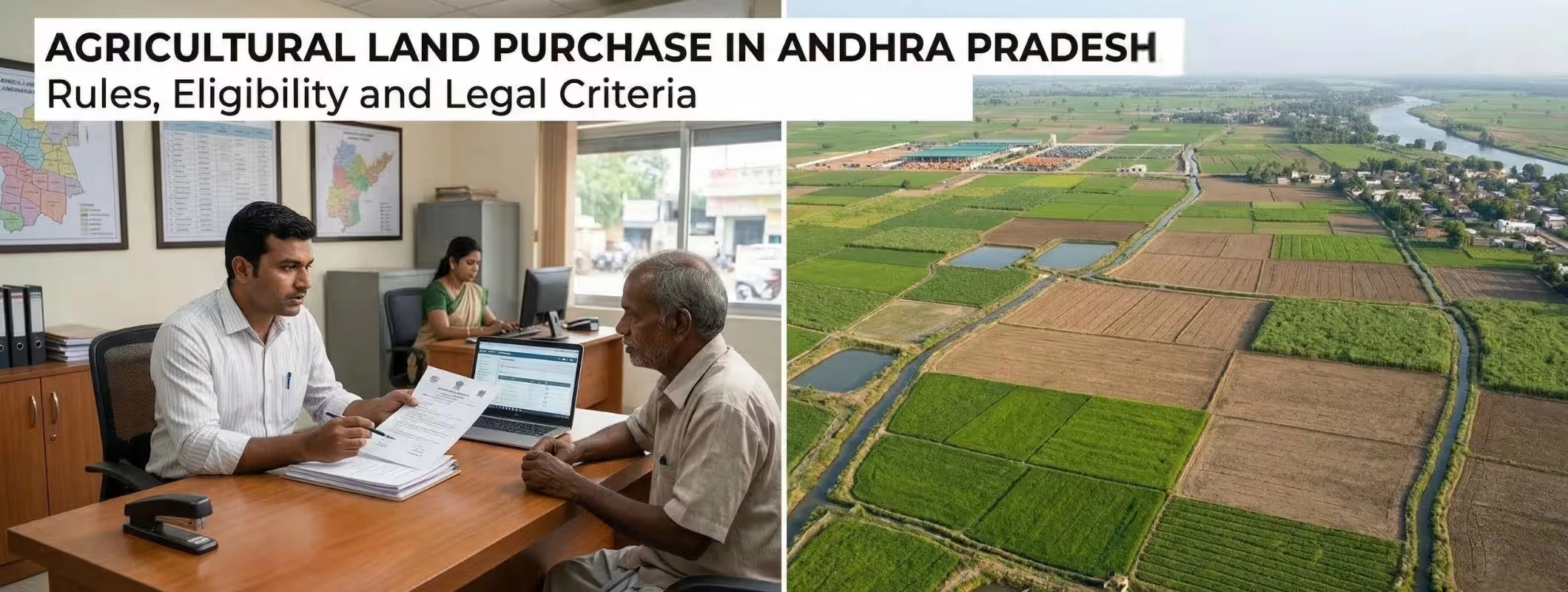
Purchasing agricultural land in Andhra Pradesh can look simple on thought, but the legal side is where most buyers make mistakes. In this state, the real question is not only whether you want to buy land, but what category of land you are buying, where it is located, whether the title is clean, and whether the transfer is legally allowed. Andhra Pradesh has active laws on ceiling limits, assigned land, Scheduled Area land, record-of-rights, and registration checks. On top of that, the state changed its non-agricultural conversion framework in September 2025, which matters if your end goal is a farmhouse, plotting project, resort, or any non-farm use.
If you are exploring agricultural land in Andhra Pradesh, farmland in India, managed farms, or long-term land investment, treat farmland purchase as a legal due-diligence exercise first and an emotional investment second. A beautiful parcel, a low price, or a verbal promise from the seller means nothing if the land falls in a prohibited category or the documents do not stand up at registration.
Who can Buy Agricultural Land in Andhra Pradesh?
For most resident Indian buyers, the practical compliance test in Andhra Pradesh is driven less by job title and more by the nature of the land and the legal status of the transfer. In the official Andhra Pradesh laws reviewed here, the hard restrictions that clearly appear are these: ceiling law compliance, prohibition on transfer of assigned lands, protection of tribal land in Scheduled Areas, and record-and-registration compliance. So, before you assume you are eligible to buy land, first confirm that the parcel itself is legally transferable.
There is one buyer category where the rule is very clear across India: NRIs and PIOs cannot generally purchase agricultural land, plantation property, or farm houses in India under RBI/FEMA rules, though inheritance and some limited routes may still apply under the law. So if the buyer is overseas, Andhra Pradesh land rules are only part of the picture; central foreign-exchange rules also apply.
The First Legal Filter: Is the Land actually Transferable?
This is where many land deals collapse. Not every parcel that is being “shown for sale” can be validly sold. In Andhra Pradesh, assigned lands are heavily restricted. The Andhra Pradesh Assigned Lands (Prohibition of Transfers) Act, 1977 says assigned land given by the government to landless poor persons cannot be transferred, and no person can acquire such land by purchase, gift, mortgage, exchange, lease, or otherwise. Transfers made in violation of this law are treated as null and void, and the law also bars registration of documents relating to such assigned lands once they are in the official list.
If a seller says, “It is old family land” or “Everybody buys like this in this village,” that is not enough. If the parcel is assigned land, the deal can become legally defective from day one. That is exactly why buyers must not rely only on local assurances. They should verify the land classification from official records before paying token money.
The Second Legal Filter: Is the land in a Scheduled Area or Tribal Belt?
If the agricultural land lies in a Scheduled Area, the risk level goes up sharply. Under the Andhra Pradesh Scheduled Areas Land Transfer Regulation, 1959, a transfer of immovable property in Agency tracts by a member of a Scheduled Tribe is absolutely null and void unless it is made in favour of another Scheduled Tribe member or a cooperative made only of Scheduled Tribe members. The same regulation also restricts registration of documents in such areas unless the transferee gives the required declaration showing that the transfer complies with the tribal-protection rule.
If you plan to buy agriculture land in a tribal or agency area, you cannot treat it like an ordinary rural purchase. Special protection laws apply there, and many deals that appear informal or “common practice” may still be unlawful. For a buyer, this is not a small technical issue. It can decide whether the land is legally purchasable at all.
The Third Legal Filter: Ceiling limits and Surplus Land issues
Andhra Pradesh also has a long-standing ceiling law through the Andhra Pradesh Land Reforms (Ceiling on Agricultural Holdings) Act, 1973. The Act fixes ceiling rules for agricultural holdings and requires a declaration to be furnished before the registering officer for land alienation documents. The law also sets a “specified limit” for declaration purposes at 10 acres of wet land or 25 acres of dry land, with conversion rules where holdings include both wet and dry land.
This does not mean every lawful purchase is capped at only those simple figures in every situation, because ceiling computation under the Act depends on land class and family-unit treatment. What it does mean is that a buyer should never ignore holding-size issues, especially when purchasing large extents, family-held agricultural blocks, or land with an old partition history. If the transaction brushes against ceiling law, the registration stage is not the place to discover it.
Why Title due diligence matters more than the sale price
A cheap land deal is often cheap for a reason. Before buying agricultural land in Andhra Pradesh, the buyer should verify the full title chain and not just one recent sale deed. Official systems in Andhra Pradesh allow access to key documents and records, including MeeBhoomi land records, Encumbrance Certificate searches, certified copies of registration documents, village map copies, and FMB sketch copies. These records help you cross-check ownership, possession history, survey boundaries, and whether the same land has already been dealt with earlier.
A careful buyer should check the seller’s registered title documents, the Record of Rights / 1-B, Adangal, FMB sketch, village map, EC, and survey details together. One document alone is not enough. When records do not match, that mismatch is the red flag. In land matters, inconsistency is often more important than what the seller says verbally.
What Documents should you verify before purchase?
At minimum, a serious buyer should verify the following before closing the deal:
- Parent title documents and recent sale deeds
- Encumbrance Certificate to see registered transactions and charges
- MeeBhoomi / ROR-1B and Adangal entries
- Pattadar passbook and title-related revenue entries
- FMB sketch and village map for boundary and survey confirmation
- Section 22A / prohibited property status
- Whether the land is assigned land, government land, ceiling-surplus land, or Scheduled Area land
- Whether subdivision is needed if only part of a survey number is being sold
Andhra Pradesh’s own service ecosystem supports several of these checks. The government services portal lists online services for Encumbrance, MeeBhoomi land records, Village Map Copy, FMB Copy, Certified Copy of Registration Document, and Sub Division Patta. That makes document-based due diligence easier than it was earlier, but only if the buyer actually uses these tools before signing.
One of the most overlooked steps is checking whether the land appears in a prohibited list under Section 22A or related district notifications. Andhra Pradesh district administration pages publish prohibited-property notices and lists, which is a strong reminder that some lands are blocked from registration because of legal defects, government claims, or protected status. If the land is flagged there, the deal can stop at registration regardless of whatever private agreement you signed with the seller.
This is why smart buyers do not ask only, “Is the seller ready?” They ask, “Is the land registrable?” That is the real test.
Buying part of a larger parcel
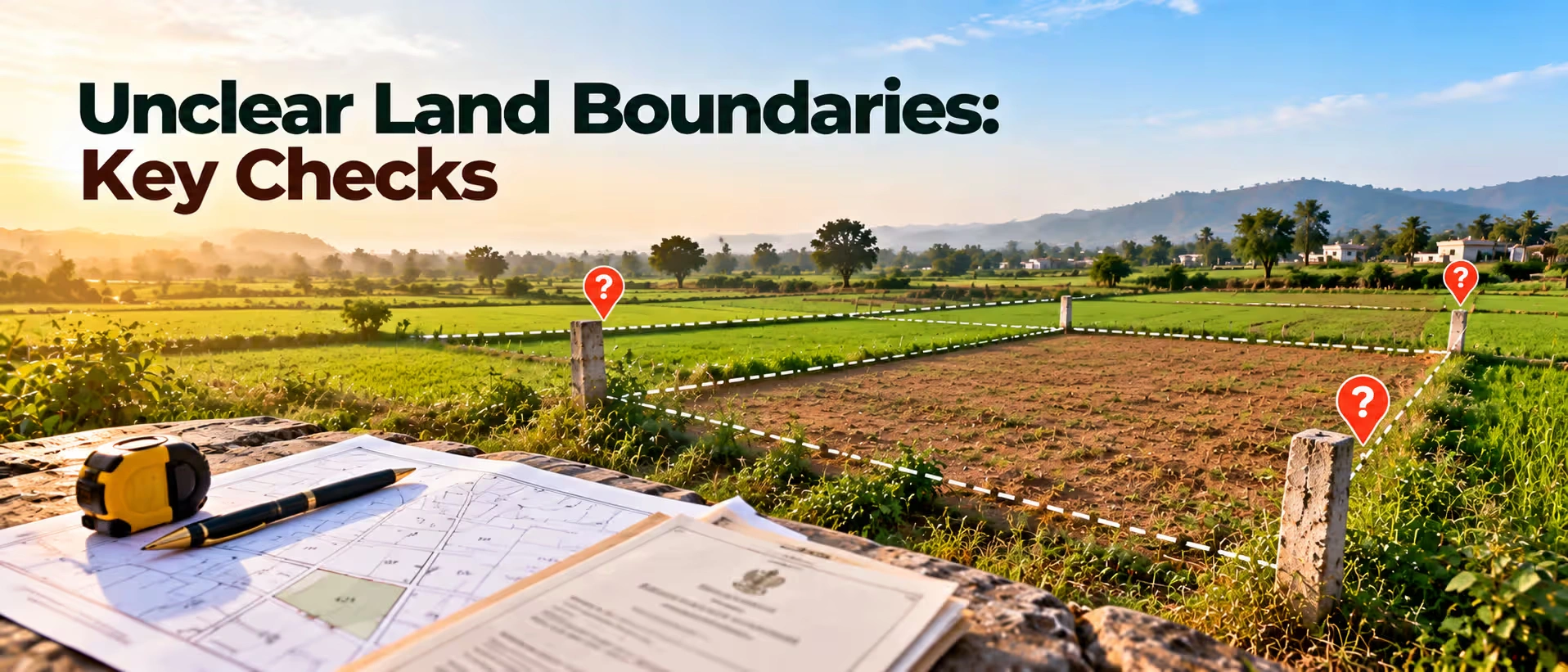
A lot of rural transactions in Andhra Pradesh involve only a piece of a larger survey number. That is where buyers get trapped in boundary disputes. Andhra Pradesh provides a Sub Division Patta service specifically for cases where a piece of land is sold to another person, and the official system also supports FMB copy access for measurement-level verification. So if you are buying a split parcel and not the entire survey number, subdivision and measurement records become essential, not optional.
Managed Farms: Good Model, but not a legal shortcut
The managed farms model is getting popular across farmland in India, especially among city buyers who want a farm investment without handling day-to-day operations. That model can work, but buyers should understand one simple truth: a managed farm is a business format, not a legal shortcut. The underlying land must still have clean title, lawful transferability, proper records, and the right usage approvals. If the underlying parcel is assigned land, prohibited land, disputed land, or wrongly marketed agricultural land, the “managed” label does not cure the defect.
So when you evaluate managed farmland in Andhra Pradesh, ask who owns the underlying title, how the land is being sold, whether the survey numbers are clean, whether the project sits on agricultural land or converted land, and what exact rights the buyer receives. If those answers are vague, walk away.
Planning to use the Land for a Farmhouse, Plotting, Resort, or Commercial Purpose?
This part matters a lot in 2026. Andhra Pradesh’s earlier law on conversion of agricultural land for non-agricultural purposes under the 2006 Act was repealed in September 2025 through Ordinance No. 5 of 2025. The ordinance states that land development regulation is now substantially handled under other local and urban development laws, and it preserves pending matters and some transitional provisions.
So if your end goal is not cultivation but a farmhouse project, villa-style development, hospitality use, layouts, or other non-farm activity, do not assume old conversion advice is still current. The compliance path now depends on the post-2025 framework of local bodies, planning authorities, development charges, and layout/building approvals. In short, buying agricultural land is one question; using it for non-agricultural purposes is a second and separate question.
A Safe step-by-step way to Buy Agricultural Land in Andhra Pradesh
Start by identifying the exact survey number, village, mandal, and extent. Then verify the land on MeeBhoomi Andhra Pradesh, pull the EC, obtain the registered title chain, review FMB and village map, and check whether the parcel is in any prohibited or protected category. After that, get a local property lawyer to vet ceiling, assigned-land, Scheduled Area, inheritance, partition, and possession risks. Only then should you move to token advance, agreement drafting, and registration.
If the land is being carved out of a bigger parcel, insist on subdivision clarity. If the seller gives only photocopies, oral history, or “old family understanding,” stop the deal until certified documents are produced. In land buying, delay is cheaper than litigation.
Final word
Buying agricultural land in Andhra Pradesh can be a strong long-term move, whether you want cultivation, passive land appreciation, or entry into the growing managed farms segment. But this is not a deal where you should rely on broker comfort, village reputation, or low pricing alone. The safest buyer is the one who checks land category, transferability, title chain, EC, survey records, prohibited status, and future-use compliance before registration. Do that properly, and your farmland purchase starts on legal ground instead of future dispute.
Frequently Asked Questions (FAQs)
1. Is buying agricultural land in Andhra Pradesh legally possible for every buyer?
For most resident Indian buyers, the key issue is not just personal eligibility but whether the land itself is legally transferable. Assigned land, Scheduled Area land, ceiling-problem land, and prohibited properties can block or invalidate a transaction even if the seller is willing. NRIs and PIOs, meanwhile, face a separate RBI/FEMA restriction on purchasing agricultural land in India.
2. What is the biggest legal mistake buyers make?
The biggest mistake is relying on one document or on oral assurances. Buyers should verify title deeds, EC, ROR-1B, Adangal, FMB sketch, village map, prohibited status, and survey details together before registration.
3. Can assigned land be purchased if the seller has been in possession for years?
Not safely. The Assigned Lands Act clearly prohibits transfer and acquisition of assigned land, and such transfers are treated as null and void. Long possession or local practice does not automatically cure that defect.
4. Is a managed farm project automatically legally safe?
No. Managed farms are a business model, not a legal exemption. The underlying land must still pass title, transfer, survey, land-category, and land-use compliance checks.
5. What if I want to buy agricultural land now and build later?
Then you must check the post-September 2025 land-use framework carefully. Andhra Pradesh repealed the 2006 agricultural land conversion law, so non-agricultural use now depends on the current approval and development framework under other laws and local authorities.